If you have ever looked at two Malibu homes with similar ocean views and wondered why they feel like they belong in completely different markets, you are not alone. Malibu is not one simple coastal market. It is a collection of micro-markets where direct sand access, bluff position, lot utility, privacy, and coastal rules can shape value just as much as square footage. This guide will help you understand how Malibu’s beach, bluff, and hill markets differ so you can make smarter buying or selling decisions. Let’s dive in.
Why Malibu Works as Micro-Markets
Malibu stretches across 21 miles of coastline, with multiple public beaches and access ways, and every part of the city sits within California’s coastal zone. That matters because a Malibu address alone does not tell you enough about a property’s lifestyle, risk profile, or market position.
The city’s Local Coastal Program influences shoreline, bluff, access, hillside, and hazard issues. In practical terms, that means two homes that look close on a map can have very different building, renovation, and long-term ownership considerations.
Public market numbers also tell different stories depending on what they measure. In late spring 2026, Zillow’s Malibu home value index was about $3.18 million, Redfin’s citywide median sale price was about $4.82 million in May 2026, and Realtor.com’s March 2026 median listing price was $5.85 million.
Those gaps are not necessarily contradictions. In a thin luxury market like Malibu, they are better used as directional guideposts than as one precise answer. A small number of high-end sales can move citywide medians quickly.
Malibu Market Conditions in 2026
Spring 2026 looked slower and more buyer-leaning than many people expect from a luxury coastal market. Redfin reported roughly 103 days on market and homes selling about 6% below list, while Realtor.com described Malibu as a buyer’s market with 73 median days on market and a 90% sale-to-list ratio.
For you as a buyer, that can mean more room to compare options and negotiate carefully. For you as a seller, it raises the importance of pricing, presentation, and strong positioning within the right micro-market.
Beachfront Market Basics
What defines beachfront in Malibu
In Malibu, beachfront usually means direct sand frontage or immediate beach access. These homes often deliver the most iconic coastal lifestyle, with oceanfront decks, close proximity to the water, and the strongest walk-to-sand appeal.
That same closeness to the shoreline also creates the most complex regulatory setting. Malibu’s Local Coastal Program says new beachfront development must minimize wave runup, flooding, and beach erosion hazards without requiring shoreline protection structures.
Why beachfront commands a premium
Beachfront tends to lead the market on lifestyle value. If your top priority is waking up right on the water, stepping out to the sand, and owning one of Malibu’s most limited property types, this is usually where that premium shows up.
Even small lots can carry major value when they include prime frontage. Malibu’s beachfront district allows new lots as small as 5,000 square feet, yet current public examples show premium pricing across a wide range of parcel sizes.
Beachfront pricing examples
Recent public examples show how broad the beachfront price range can be:
- 31224 Broad Beach Rd is listed at $35 million on 0.38 acres with direct oceanfront access.
- 18954 Pacific Coast Hwy is listed at $8.495 million with about 57 feet of beach frontage.
- 25360 Malibu Rd is listed at $6.999 million for a 7,837-square-foot beachfront lot already partway through city approval.
Neighborhood snapshots also show the same luxury profile, though with small-sample volatility. Malibu Colony’s recent median sale price was $4.55 million with 66 days on market, while Malibu Road’s recent median sale price was $6.9 million with 77 days on market.
Beachfront tradeoffs to consider
Beachfront usually wins on convenience and direct lifestyle appeal. You are paying for immediacy, scarcity, and a very specific coastal experience.
The tradeoff is that beachfront ownership can bring more exposure to erosion, flooding, public access considerations, and entitlement complexity. For sellers, those factors can shape buyer due diligence. For buyers, they should be part of the decision from the start.
Bluff-Top Market Basics
What defines bluff-top property
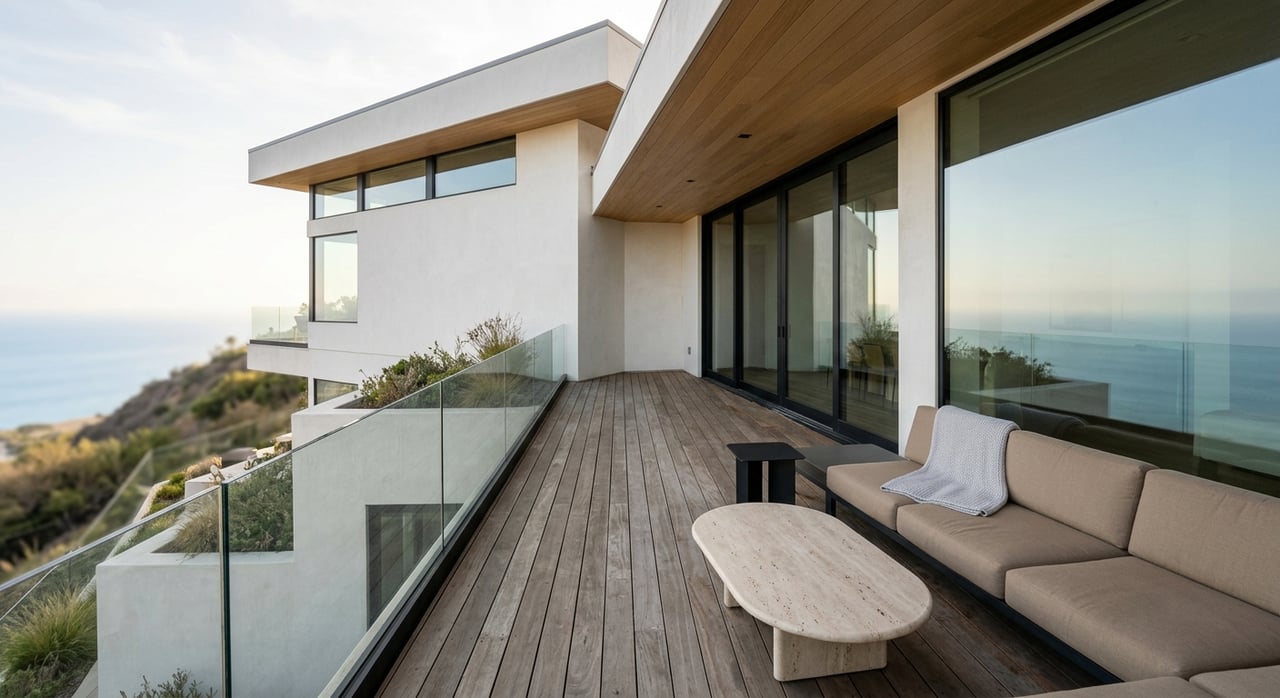
Bluff-top homes are often about perspective rather than direct contact with the sand. You get elevated ocean and whitewater views, a bit more separation from beach activity, and often a quieter daily feel.
Many buyers see bluff-top property as a middle ground between beachfront intensity and hillside privacy. It can offer a strong combination of scenery, privacy, and day-to-day livability.
Why bluff-top appeals to buyers
Bluff-top homes often trade direct sand access for wider views and more buffer. In some cases, they also offer better odds of a flatter pad or more usable outdoor space than a steep hillside property.
That does not mean bluff-top is simple. Malibu’s Local Coastal Program restricts new bluff-top development and lot creation if it would require future bluff or shoreline protection, so these properties still sit inside an important coastal hazard framework.
Bluff-top pricing examples
Public listings and recent sales show a broad bluff-top range:
- 3711 Oceanhill Way in Sunset Mesa is listed at $1.295 million on 7,087 square feet with ocean views.
- 18431 Coastline Dr is a 7,723-square-foot ocean-view lot with permitted plans and protected view corridors.
- 33020 Pacific Coast Hwy on Encinal Bluffs is listed at $8 million on 0.88 acres with deeded beach access.
- 29851 Pacific Coast Hwy above Zuma Beach sold for $8.65 million with 2.69 acres and about 260 feet of bluff frontage.
These examples show why bluff-top is hard to summarize with one number. The value often depends on view quality, privacy, lot shape, usable outdoor area, and whether there is deeded beach access.
Bluff-top tradeoffs to consider
Bluff-top property can be a strong fit if you want elevated views and a calmer feel than direct beachfront living. It often appeals to buyers who want a scenic coastal setting without being right on the sand.
The tradeoff is that bluff properties can still involve erosion concerns, permit limitations, and view-related constraints. That is why the best bluff-top opportunities are often judged by both beauty and practicality.
Hill and Canyon Market Basics
What defines Malibu’s hill market
Malibu’s hills and canyons are the most varied part of the market. This is where you often find more privacy, more acreage, and less beach noise, along with the widest spread in pricing.
These properties can feel very different from one another, even within the same general area. Ocean view, road access, driveway design, slope, and usable pad space can all have a major effect on value.
Why hill properties vary so much
A hillside acre is not always equal to another hillside acre. A property that has a flatter building pad, a functional driveway, a pool terrace, and a protected view corridor can behave very differently in the market than a larger parcel that is mostly slope.
That is one reason Malibu’s hill market shows such a wide range of outcomes. Buyers are not just comparing lot size. They are comparing utility.
Hill market pricing examples
Public data highlights that range clearly:
- Malibu Park’s May 2026 median sale price was $4.34 million with 205 days on market.
- 29600 Harvester Rd is listed at $17.9 million on 3.3 acres with panoramic ocean views.
- 4140 Encinal Canyon Rd is a 2.38-acre view lot listed at $3.995 million.
- 26570 Ocean View Dr reflects a smaller canyon-home model with 9,000 square feet of land and a much lower absolute price point in prior sale history.
For buyers, this means the hill market can offer more choice across price bands. For sellers, it means your home’s specific site utility and presentation can matter even more than broad neighborhood averages.
Hill market tradeoffs to consider
Hills and canyons usually win on privacy, land, and quiet surroundings. If your ideal Malibu lifestyle centers on space and separation, this part of the market may feel especially compelling.
The tradeoffs include more driving, more topography-driven site work, and more planning around natural hazards. Malibu’s Local Coastal Program notes vulnerability to landslides, wildfires, earthquakes, storm waves, and flooding, and it specifically notes that steep hillsides are subject to erosion accelerated by fires, torrential rains, and winter storms.
How to Compare Beach, Bluff, and Hill Homes
If you are comparing Malibu property types, it helps to focus on a few practical questions:
- How important is direct beach access to your daily lifestyle?
- Do you prefer elevated views with more buffer from activity?
- How much privacy and land do you want?
- How usable is the lot beyond the headline acreage?
- What level of permitting or hazard review are you comfortable navigating?
In many cases, the best choice is less about which micro-market is objectively best and more about which one best matches how you want to live. Malibu value is deeply tied to lifestyle fit.
What This Means for Buyers and Sellers
For buyers, Malibu rewards a property-by-property approach. Citywide medians can be helpful for context, but they do not replace close review of location, lot utility, access, and regulatory setting.
For sellers, the same micro-market logic matters when positioning a home. A beachfront property should be framed around frontage and lifestyle appeal, a bluff-top property around views and livability, and a hill property around privacy, land utility, and setting.
In a slower, buyer-leaning luxury market, that level of clear positioning matters even more. The homes that stand out usually do so because their value story is easy for buyers to understand.
If you are thinking about buying or selling in Malibu, working with a team that understands coastal positioning, luxury presentation, and how to market each micro-market can make a real difference. Justin Dutchover Real Estate helps buyers and sellers navigate Malibu with tailored guidance, polished marketing, and a strong understanding of coastal luxury property.
FAQs
What is the difference between Malibu beachfront and bluff-top homes?
- Beachfront homes usually offer direct sand access and the strongest walk-to-beach lifestyle, while bluff-top homes usually offer elevated views, more separation, and a balance between scenery and privacy.
How do Malibu hill properties differ from beach properties?
- Malibu hill properties usually offer more privacy, acreage, and quiet, while beach properties usually offer closer water access and a stronger lifestyle premium tied to the shoreline.
Why do Malibu home prices vary so much by location?
- Malibu prices vary because the city functions as several micro-markets, and value can change based on beach access, bluff position, lot utility, privacy, views, and coastal or hillside constraints.
Is Malibu a buyer’s or seller’s market in 2026?
- Spring 2026 public data described Malibu as a slower, buyer-leaning luxury market, with longer days on market and sale prices often landing below list price.
What should buyers focus on in Malibu’s hill market?
- Buyers should focus on lot utility, including pad space, slope, driveway access, outdoor usability, and view orientation, because raw acreage alone does not tell the full story.
What should sellers highlight in Malibu’s micro-markets?
- Sellers should match the property story to the micro-market, emphasizing direct access and frontage for beachfront homes, view and livability for bluff-top homes, and privacy, land, and utility for hill properties.